
If you’re new to forex trading, you’ve probably come across terms like pip, leverage, and margin. At first, these words may seem confusing, but they are among the most important concepts every trader should understand before opening a trade.
Whether you’re trading with a demo account or planning to invest real money, knowing how pips, leverage, and margin work will help you understand price movements, calculate profits and losses, and manage your risk more effectively.
In this guide, we’ll break down each concept in simple terms, explain why it matters, and show how they all work together in forex trading.
What Is a Pip in Forex?
One of the first terms every beginner encounters in forex trading is pip.
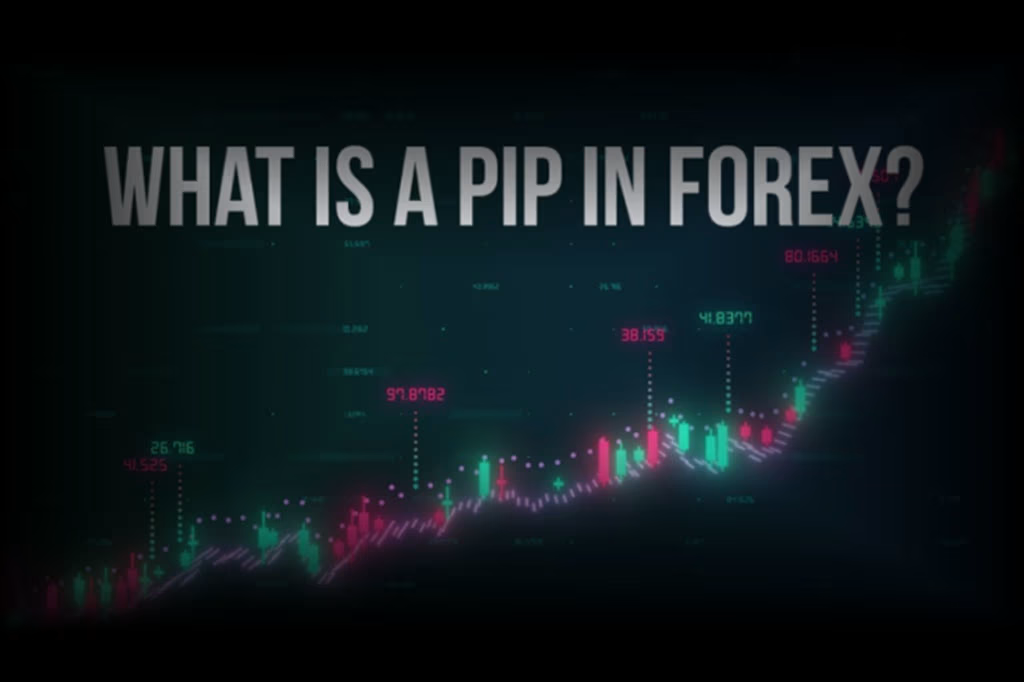
A pip (Percentage in Point or Price Interest Point) is the standard unit traders use to measure how much the price of a currency pair moves. Think of it as the “measuring tape” of the forex market. Without pips, it would be difficult to determine whether a trade made or lost money.
For most currency pairs, one pip equals 0.0001, which is the fourth decimal place. However, for Japanese Yen (JPY) pairs, one pip is 0.01, or the second decimal place.
For example:
- EUR/USD moves from 1.1200 to 1.1208.
- The price has increased by 8 pips.
Another example:
- USD/JPY moves from 145.20 to 145.35.
- The pair has moved 15 pips.
Every time you hear a trader say, “The market moved 20 pips,” they’re referring to the number of price points the currency pair has gained or lost.

Why Are Pips Important in Forex Trading?
Understanding pips is essential because almost every trading decision revolves around them.
They Measure Market Movement
Pips provide a simple and universal way of measuring how much a currency pair has moved.
Instead of saying,
“EUR/USD increased from 1.1200 to 1.1235,”
most traders simply say,
“EUR/USD gained 35 pips.”
This makes communication much easier across the global forex market.
They Determine Your Profit or Loss
Every profit or loss in forex is calculated using pips.
For example, if you buy EUR/USD at 1.1200 and sell at 1.1230, you’ve gained 30 pips.
The amount you earn depends on your lot size and the value of each pip.
They Help You Manage Risk
Professional traders don’t enter the market without a plan.
Instead, they use pips to set:
- Stop-loss orders
- Take-profit levels
- Risk-to-reward ratios
For instance, you might risk 20 pips to target a profit of 60 pips, giving you a favourable risk-to-reward ratio.
They Measure Volatility
Some currency pairs move only 30 to 50 pips in a day, while others can move over 150 pips.
Knowing the average daily pip movement helps traders choose suitable trading opportunities and avoid unnecessary risk.
Key Takeaway
A pip is much more than a small price movement. It is the standard measurement used to calculate profits, losses, risk, and market volatility. Without understanding pips, it becomes difficult to trade confidently.
What Is Leverage in Forex?
Now that you understand pips, let’s look at another important concept—leverage.
Leverage allows traders to control a much larger trading position than the amount of money they actually have in their account.
In simple terms, your broker lends you additional buying power so you can trade larger positions with a relatively small investment.
Imagine you have $500 in your trading account.
Without leverage, your trading opportunities would be quite limited.
However, if your broker offers 1:100 leverage, your $500 gives you control over a position worth $50,000.
That’s why leverage is often described as a powerful tool—but one that should be used carefully.
Why Is Leverage Important?
It Increases Buying Power
One of the biggest advantages of leverage is that it allows traders with smaller accounts to participate in the forex market.
Without leverage, many traders wouldn’t have enough capital to open meaningful positions.
It Can Increase Potential Profits
Forex prices often move by relatively small amounts.
Leverage magnifies those small movements, meaning a successful trade can generate a larger return than it otherwise would.
For example, a 40-pip move may produce only a modest gain without leverage, but with leverage, the same market movement could result in a significantly higher profit.
It Gives Traders More Opportunities
Leverage allows traders to spread their capital across multiple trades instead of committing all their money to one position.
This flexibility can be useful when managing different currency pairs or trading strategies.
The Risks of Leverage
Although leverage can increase profits, it also increases losses.
For example, imagine you open a highly leveraged trade expecting the market to rise.
If the market moves against you instead, your losses will also be magnified.
This is why experienced traders often advise beginners to start with lower leverage while learning proper risk management.
Key Takeaway
Leverage is a useful trading tool because it increases your buying power, but it should always be used responsibly. High leverage can lead to large profits, but it can also wipe out your trading account if not managed properly.
What Is Margin in Forex?
Many beginners confuse margin with leverage, but they are not the same.
While leverage increases your buying power, margin is the amount of money your broker requires you to set aside before you can open a leveraged trade.
Think of margin as a security deposit.
It isn’t a fee, and it doesn’t disappear from your account. Instead, it is temporarily reserved while your trade remains open.
How Does Margin Work?
Suppose you want to open a trade worth $20,000.
If your broker requires a 2% margin, you only need to have $400 in your trading account to open that position.
The remaining value of the trade is made possible through leverage.
This is why leverage and margin always work together.
Why Is Margin Important?
It Allows You to Open Trades
Without sufficient margin, your broker won’t allow you to open a leveraged position.
Your available margin determines how many trades you can place.
It Helps Protect Your Account
Margin helps ensure that traders have enough funds to cover potential losses.
It also protects brokers from excessive risk.
It Shows the Health of Your Trading Account
As your trades move, your account balance changes.
When your losses become too large, your available margin decreases.
If it falls below the broker’s required level, you may receive a margin call.
What Is a Margin Call?
A margin call occurs when your account no longer has enough available funds to support your open positions.
When this happens, your broker may:
- Ask you to deposit more money.
- Prevent you from opening new trades.
- Automatically close some or all of your losing positions.
Margin calls are usually the result of using excessive leverage or failing to manage risk properly.
Key Takeaway
Margin acts as the financial cushion that keeps your leveraged trades open. Monitoring your margin level is essential because it helps you avoid unexpected trade closures.
How Pip, Leverage and Margin Work Together
Understanding each concept individually is important, but knowing how they work together is what makes you a better trader.
Imagine you have:
- Account balance: $1,000
- Leverage: 1:100
- Trade size: $50,000
Because you’re using leverage, you don’t need the full $50,000 to open the trade. Instead, your broker may require only a fraction of that amount as margin.
Once the trade is open, every market movement is measured in pips.
If the market moves 30 pips in your favour, you make a profit.
If it moves 30 pips against you, you incur a loss.
If your losses continue to grow, your available margin decreases. Once it drops below your broker’s minimum requirement, you may receive a margin call or have your positions closed automatically.
In simple terms:
- Pips measure market movement.
- Leverage increases your buying power.
- Margin keeps your leveraged trade open.
Together, they form the foundation of every forex transaction.
Common Mistakes Beginners Make
Many new traders lose money not because they can’t predict the market, but because they misunderstand these basic concepts.
Some common mistakes include:
- Using very high leverage to chase quick profits.
- Ignoring stop-loss orders.
- Opening trades without calculating pip values.
- Not monitoring margin levels.
- Risking too much on a single trade.
Learning to avoid these mistakes can significantly improve your chances of long-term success.
Final Thoughts
Every successful forex trader starts by mastering the basics.
Pips tell you how much the market has moved. Leverage allows you to control larger positions with less capital, while margin is the amount required to keep those positions open.
Although these concepts may seem technical at first, they become much easier to understand with practice. Before trading with real money, spend time practising on a demo account, learn how to calculate pip values, understand how leverage affects your trades, and always keep an eye on your margin level.
The more you understand these three concepts, the better equipped you’ll be to manage risk, make informed trading decisions, and build a solid foundation for your forex trading journey.
Ready to begin? Open an account, join our trading community and start your forex journey here.
ALSO READ: How to Start Forex Trading with $100: A Beginner’s Complete Guide