Forex trading has become one of the most popular ways people try to build wealth online. With thousands of traders entering the market daily, one question keeps coming up: Can I start forex trading with just $100?
The simple answer is yes.
You don’t need thousands of dollars to start trading forex. In fact, many successful traders began with small accounts. Thanks to modern brokers offering low minimum deposits, micro-lot trading, and leverage, starting with $100 has become more realistic than ever.
But here’s the truth many people won’t tell you—starting with $100 is not about getting rich quickly. It’s about learning, building discipline, and understanding the market without risking too much money.
If you’re serious about entering the forex market with a small budget, this guide will walk you through everything you need to know.
What is Forex Trading?
Forex (foreign exchange) trading is the process of buying and selling currencies to make a profit from changes in their value.
For example, if you buy the EUR/USD pair and the euro increases in value against the dollar, you can make a profit when you sell.
The forex market is the largest financial market in the world, with over trillions of dollars traded daily. Unlike stock markets, forex operates 24 hours a day, five days a week, giving traders flexibility.
This makes it attractive to beginners because you can trade at almost any time.
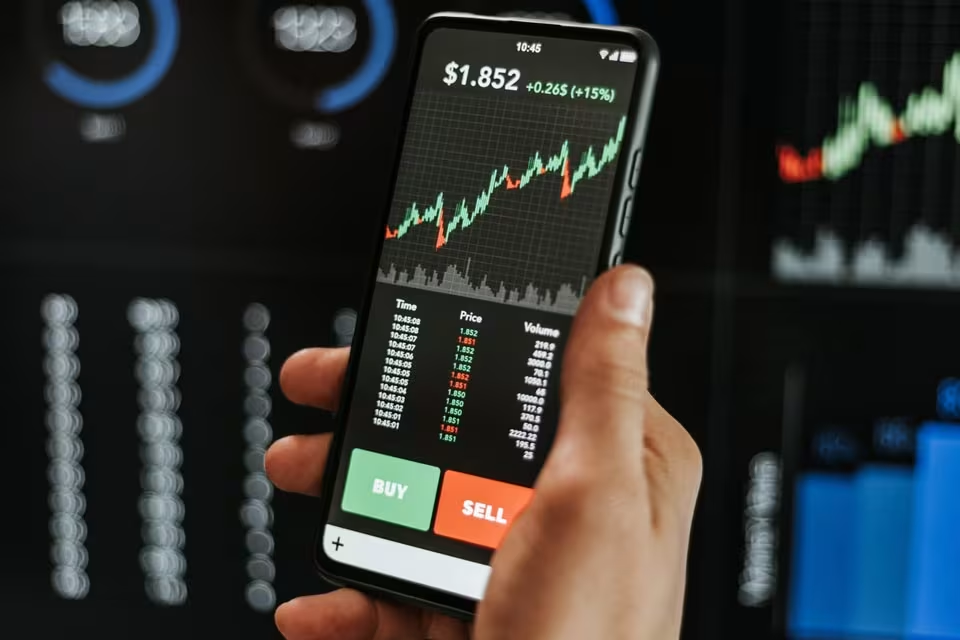
Can You Really Start with $100?
Yes, but your expectations need to be realistic.
Starting with $100 means you’ll be working with limited capital. That means:
- Smaller profits
- Smaller losses
- Less room for mistakes
However, it also means less financial pressure.
Think of your first $100 as your tuition fee into the forex market. Instead of focusing on how much profit you can make, focus on how much you can learn.
The goal at this stage is not to turn $100 into $10,000 overnight. The goal is to survive, gain experience, and improve.
Step 1: Learn the Basics First
Before you put your money into forex, you need to understand how the market works.
Many beginners rush into trading because they see social media screenshots of profits. What they don’t see are the losses, mistakes, and years of learning behind those profits.
Here are some important forex terms you must understand:
Currency Pairs
Forex trading involves pairs like:
- EUR/USD
- GBP/USD
- USD/JPY
The first currency is the base currency, while the second is the quote currency.
Pips
A pip is the smallest movement in price.
It determines how much profit or loss you make.
Leverage
Leverage allows you to control larger trades with smaller money.
For example, with 1:100 leverage, your $100 can control $10,000.
This can increase profits—but also losses.
Spread
This is the difference between the buying and selling price.
The lower the spread, the better for traders.
Without understanding these basics, trading becomes gambling.
Step 2: Choose the Right Broker
Your broker is your gateway into the forex market.
Not all brokers are the same, so choosing wisely matters.
A good broker should offer:
- Low minimum deposit
- Tight spreads
- Fast withdrawals
- Strong regulation
- Demo accounts
- Good customer support
Since you’re starting with $100, look for brokers that allow micro-lot trading. This will help you manage risk better.
Avoid brokers with hidden charges or unrealistic promises.
Step 3: Open a Demo Account First
This step is often ignored, but it’s one of the most important.
A demo account allows you to trade with fake money while practicing in real market conditions.
Benefits of demo trading:
- Learn how to place trades
- Understand charts
- Practice strategies
- Build confidence
Spend time here before risking your real $100.
The more mistakes you make in demo, the fewer you’ll make in live trading.
Step 4: Fund Your Live Account
Once you understand the basics and feel comfortable, you can deposit your $100.
At this stage, mindset matters.
Do not fund your account expecting quick money.
Fund it knowing:
- You may lose some of it
- You are still learning
- Your focus is growth
This mindset protects you from emotional decisions.
Step 5: Master Risk Management
This is where most traders fail.
Risk management is what keeps your account alive.
A common rule is the 1–2% rule.
If your account is $100:
- Risk $1 per trade
- Maximum $2 per trade
This means even if you lose multiple trades, your account can survive.
Always use:
- Stop-loss
- Take-profit
- Proper lot size
Never go “all in.”
One bad trade can wipe out your account.
Step 6: Pick One Strategy and Stick to It
There are many trading strategies, but trying all of them at once can be confusing.
As a beginner, focus on one.
Popular strategies include:
Scalping
Quick trades for small profits.
Best for traders who can monitor the market constantly.
Day Trading
Trades are opened and closed in one day.
Good for active traders.
Swing Trading
Trades last several days.
Best for those who can’t watch charts all day.
Whichever strategy you choose, stick with it long enough to understand it.
Jumping from one strategy to another slows your progress.
Step 7: Control Your Emotions
Trading is not just technical—it’s psychological.
Many traders lose because of emotions.
Common emotional mistakes:
- Revenge trading after losses
- Greed after profits
- Fear of missing out (FOMO)
- Overtrading
You need discipline.
A good trader follows the plan, win or lose.
Remember: not every day is a trading day.
Step 8: Keep a Trading Journal
A trading journal helps you improve faster.
Write down:
- Why you entered the trade
- Where you placed stop-loss
- Where you took profit
- What happened
- What you learned
Over time, you’ll spot your strengths and weaknesses.
This is one of the fastest ways to grow as a trader.
How Much Can You Make with $100?
This depends on:
- Your strategy
- Risk management
- Skill level
- Market conditions
Realistically, don’t expect huge profits.
If you make 5–10% monthly consistently, that’s already good.
That means:
- $5 to $10 per month on a $100 account
It may seem small, but consistency builds over time.
Many traders grow through compounding.
Final Thoughts
Starting forex trading with $100 is possible, and for many beginners, it’s actually a smart way to begin.
It limits your risk while giving you real market experience.
But success won’t come from luck.
It will come from:
- Learning
- Discipline
- Patience
- Risk management
- Consistency
If you approach forex with the right mindset, your first $100 can be the beginning of something much bigger.
Start small. Learn deeply. Grow steadily.
Ready to begin? Open an account, join our trading community and start your forex journey here.
also read up: https://affs.click/itVoF